By Christopher B. Smith — Red Seal Carpenter and BCIN-licensed designer, Woodsmith Construction. East Toronto.
Most renovation contracts are built on a promise that sounds reassuring: decide everything up front, lock it in, and nothing will change. In an older Toronto house, that promise rarely holds. And it takes away the best moment you’ll have to get your home right.
At Woodsmith, we build the other way. You can change your mind as the house takes shape, see what the change will look like, and know what it costs before you say yes.
The moment people really see their house
Plans are where a renovation starts, but they aren’t where most people understand it. That happens on site, once the framing is up.
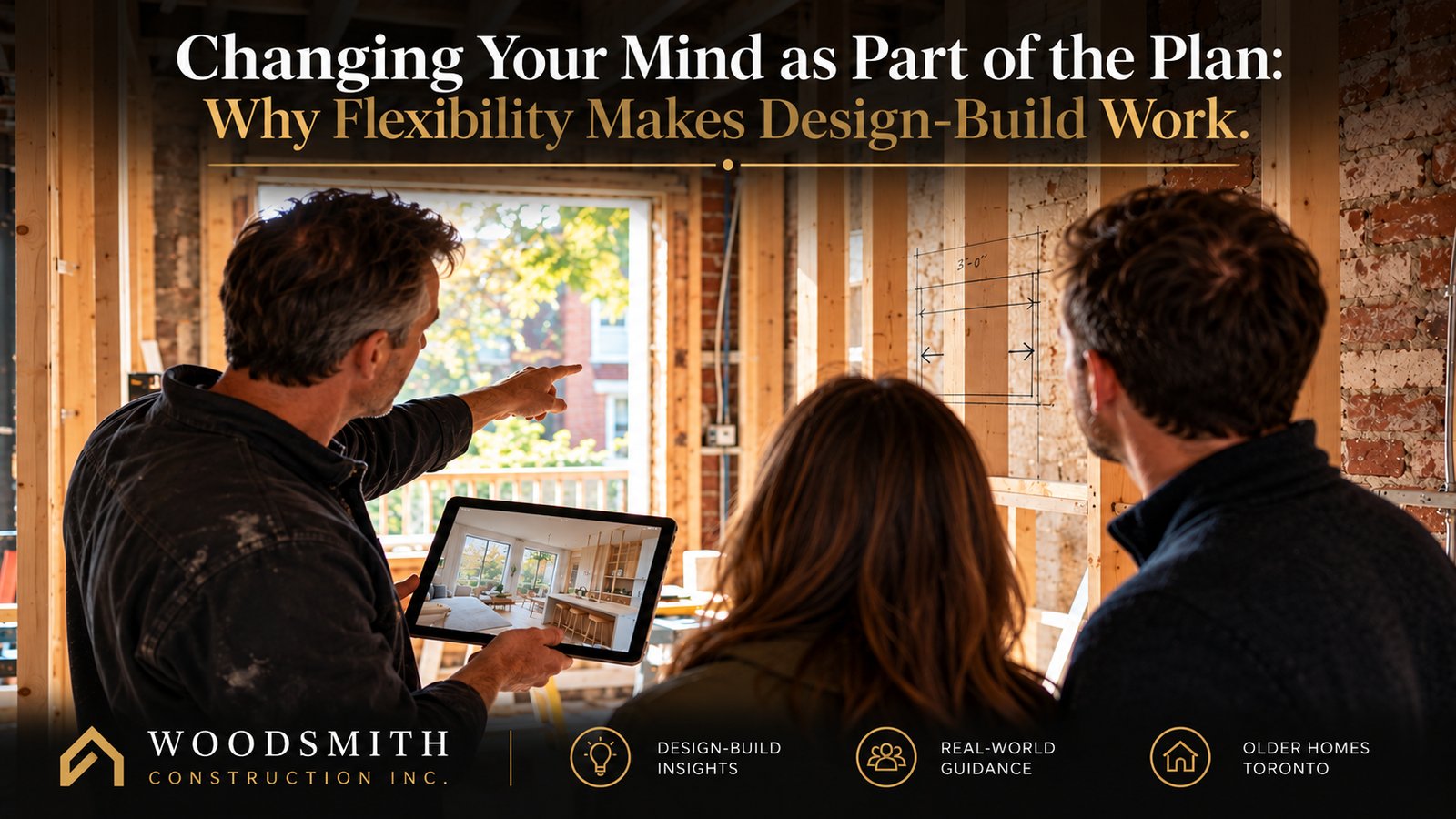
“Even though things look like they can work in plan, when you’re actually in construction and you see the framing, small adjustments can make massive differences”, says Chris Smith, Woodsmith’s owner and designer. “It’s much easier for people to understand what they’re going to live in and look at when they see it framed in the wood.”
The changes we see most often at that stage are layouts and windows. A wall moves a foot, a window gets wider or drops lower, an opening shifts so the light lands where you’ll actually sit. On paper these are small details. Standing in the room, they decide how the house feels.
It’s also when the scale of the project sinks in. “A lot of people get very excited once they see the house framed”, Chris says. “They’re like, ‘Hey, I’m doing this once in my life. I want to make my forever home.’” Sometimes that means a bigger window, a better finish or a room finished properly instead of later. We think that choice should be open to you while it still counts.
How a change works on a Woodsmith job
Every change follows the same loop, so nothing is decided blind:
- You ask “what if…” On site, on a call or in a message.
- We show you. Depending on the change, that means updated renderings, revised drawings, samples in the house or a mock-up on the framing.
- We price it. You see what the change adds or saves before any work goes ahead.
- You decide. Yes, no, or something in between. Then the drawings, the schedule and the budget update together.
Interior design and 3D renderings stay open the whole way through. You can revise them as often as you need at no extra charge. The only changes that call for formal revisions are a major layout change, a change of selections, or added scope. If a change means revising the permit drawings, there’s a small revision fee.
When a selection goes over budget or disappears
Some selections come back more expensive than planned. Others are discontinued or stuck on a long lead time. There’s no single fixed response. Depending on the situation, we:
- re-select together, with alternatives and their prices side by side;
- find the money elsewhere, so the total holds;
- or show you the real cost and let you decide whether it’s worth it.
“We want to make sure that the client is extremely happy with what they want”, Chris says, “and that that’s the best that they can get.” The point is that you make the decision with the numbers in front of you, rather than inheriting one.
Why “locked in” isn’t as safe as it sounds
A fixed price on a fully locked set of drawings feels like certainty. In an older house it rarely is. Walls open up and show you things no drawing could. Products change. Lead times slip.
“There’s no such thing as locked in”, Chris says, “unless you’re paying a massive sum of money as a margin of error, because there are lots of unfound and unknown circumstances.”
That margin is real money. It’s built into the price whether or not the surprises happen. Being locked in doesn’t buy much schedule security either. “Being locked into something from the beginning doesn’t necessarily give you any more schedule security”, Chris says. Every project waits on something, and a small change can usually be made while the trades are working through what’s already on order.
That’s why our design is a fixed price and our construction is cost-plus, open-book. You pay for the house you actually get, not for a contingency against the house you might have got. Read more in fixed-price vs cost-plus contracts and why renovation quotes vary.
The honest trade-off
Flexibility isn’t free of friction, and we won’t pretend it is. Changes can add time. A run of small yeses can add up. Open choices take energy to make. Chris is candid about it: “From the outside, it’s not the most efficient way to do it.” No project avoids those pressures entirely, flexible or not.
What makes it worthwhile is the result. “It’s just what it takes to make something that’s beautiful in today’s world and something that a client loves”, he says. “It’s just a lot of work.”
That work falls on us: tracking every decision, keeping the budget current, sequencing changes around what’s already in motion.
Is this way of building right for you?
We believe design-build is the better way to renovate or build, when it’s done properly. Chris says: “It has to have the interaction and the client communication from start to finish, and the end product will work much better.”
It fits less well in two cases:
- The project is small and simple. A one-room job with little to design doesn’t need the full design-build process or cost-plus pricing.
- You can’t stay involved. This approach depends on you making decisions as the house takes shape. If you need to hand it off and walk away, a different approach may suit you better.
For everything else, especially an older house you plan to stay in, it’s how we’d want our own home built. More on the approach is in Design-Build in Toronto: Why We Design and Build Under One Roof. For how the design itself keeps evolving once the walls are open, read why renovation design continues to evolve during construction.
The one thing to remember: you’re doing this once. You should be able to change your mind while it still counts.
Planning a renovation you want to get right the first time? We would be glad to walk the house with you.
Frequently asked questions
Yes. We show you what the change will look like and what it will cost before any work goes ahead, and you decide.
Interior design and 3D rendering revisions are included throughout the project. Revisions to the permit drawings carry a small fee, more for a large change.
We look at alternatives with you, find savings elsewhere, or show you the real cost so you can decide. It depends on the situation and on what matters most to you.
Design is a fixed price. Construction is cost-plus and open-book, so you see the real cost of every change.
Changes can add time, and we tell you when they will. A locked-in contract doesn’t guarantee a schedule either. Every renovation waits on something, and small changes can usually be worked in while that happens.