




🏡 What Is the Right Price to Pay for a Renovation on a Century Home?
Renovating a century home in Toronto isn’t just a construction project—it’s a negotiation with history.
These homes carry character, craftsmanship, and charm that simply can’t be replicated. But they also come with unknowns, outdated systems, and structural realities that make pricing far less predictable than a renovation on a newer home.
So the question becomes: what is the “right” price to pay?
The honest answer is this: the right price isn’t the lowest number—it’s the number that reflects the true scope of work required to do it properly.
–## 🧱 Why Century Homes Are Different
Most homes in Toronto built 80–120 years ago were constructed using methods and materials that don’t align with today’s building standards.
That means before you even begin to think about finishes, there are often foundational issues to address:
- Outdated electrical systems (knob-and-tube wiring)
- Aging plumbing systems (galvanized or lead piping)
- Structural modifications from previous renovations
- Insufficient insulation and poor air sealing
- Settlement and framing irregularities
What looks like a “cosmetic” renovation on the surface often becomes a full systems upgrade behind the walls.
⚠️ The Biggest Pricing Mistake Homeowners Make
The most common mistake we see is comparing renovation quotes as if they are equal.
They’re not.
Two contractors can walk through the same home and produce wildly different numbers—not because one is overcharging, but because they are making different assumptions about what’s required.
Lower quotes often rely on:
- Minimal investigation into existing conditions
- Allowances instead of fixed scopes
- Deferring necessary upgrades
- Optimistic assumptions about structure and services
Higher (and more accurate) quotes tend to:
- Account for full system upgrades
- Include contingencies for hidden conditions
- Reflect realistic labour for complex work
- Integrate design, engineering, and permitting properly
💰 What Drives the Cost of a Century Home Renovation
📐 1. Scope Clarity
The more defined your project is, the more accurate your pricing will be.
Design-build projects typically result in tighter cost control because design decisions are aligned with construction realities from the beginning.
🔨 2. Level of Intervention
Are you refreshing finishes—or reworking the structure?
- Cosmetic renovation: Lower cost, fewer unknowns
- Partial renovation: Moderate cost, some systems upgrades
- Full gut renovation: Highest cost, most predictable long-term outcome
Ironically, partial renovations often carry the most risk, because they leave older systems in place while introducing new ones.
🔍 3. Unknown Conditions
No matter how thorough the planning, century homes will always have surprises.
Opening walls often reveals:
- Improvised past work
- Structural inconsistencies
- Moisture damage
- Non-compliant framing
A realistic budget includes a contingency to handle these discoveries without derailing the project.
🎨 4. Design Expectations
There is a wide gap between “builder-grade” and highly customized design.
Century homes often deserve a thoughtful approach that balances:
- Preservation of character elements
- Modern functionality
- High-performance building practices
The more refined the design, the more coordination and craftsmanship required.
🧠 5. Contractor Approach
Not all contractors approach these homes the same way.
A contractor experienced with older Toronto homes will:
- Anticipate structural and system upgrades
- Plan sequencing carefully
- Price with fewer surprises later
An inexperienced approach can appear cheaper upfront—but often leads to significant cost increases mid-project.
💸 So… What Should You Expect to Pay?
Per-square-foot pricing gets used a lot in our industry—but for century homes, it’s often misleading.
Why?
Because the condition of the home—and what’s hiding behind the walls—has a far greater impact on cost than the size of the project alone.
A more accurate way to think about pricing is in project-based ranges tied to scope and existing conditions.
Realistic Cost Ranges Based on Project Type
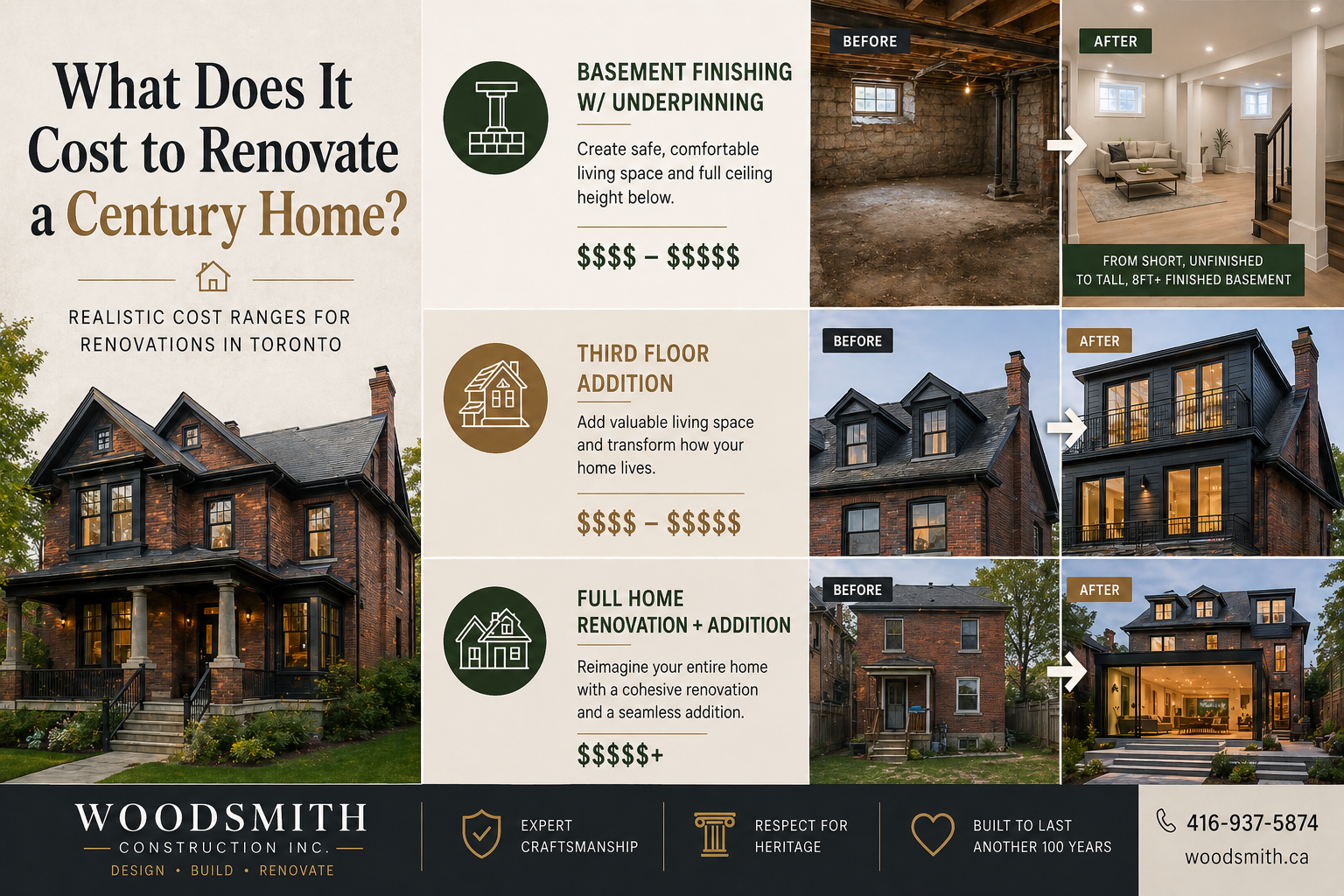
🏗️ Third Floor Addition
Typical Range: $440,000 – $750,000+
Best suited for adding meaningful space without fully rebuilding the home — assuming the existing structure, foundation and stair geometry can carry it.
What drives the cost here isn’t just the new space—it’s what the existing house can handle.
Key variables include:
- Structural capacity of existing walls and foundation
- Need for reinforcement or load redistribution
- Roof removal and full rebuild
- Stair integration and layout constraints
- Upgrading mechanical systems to serve the new space
Common hidden challenges:
- Undersized or compromised existing framing
- Previous renovations that altered load paths
- Limited ceiling heights on lower floors affecting stair design
🏠 Basement Finishing W/Underpinning
Typical Range: $190,000 – $375,000+
Ideal when the goal is to unlock usable basement space, but costs remain highly sensitive to soil conditions and foundation integrity. The upper end assumes underpinning is required.
This is one of the most technically demanding renovations in a century home.
You’re not just adding space—you’re rebuilding the foundation while the house is still standing.
Key variables include:
- Soil conditions and water table
- Existing foundation type and condition
- Access constraints (tight urban lots)
- Drainage and waterproofing requirements
- Integration with new mechanical systems
Common hidden challenges:
- Rubble or deteriorated foundations
- Groundwater intrusion
- Structural instability during staged excavation
- Poor or non-existent footings
🏡 Full Home Renovation with Addition
Typical Range: $750,000 – $1,500,000+
The most comprehensive approach—suited for homeowners looking to fully modernize, reconfigure, and expand while solving underlying structural and system challenges.
This is where century home renovations become truly transformative—but also where pricing varies the most.
These projects combine:
- Structural upgrades
- Full system replacements (electrical, plumbing, HVAC)
- Layout reconfiguration
- New addition construction
Common hidden challenges:
- Layered renovations from different eras
- Outdated or unsafe building practices
- Major structural corrections required
- Extensive air sealing and insulation upgrades needed for performance
📊 Visualizing the Investment
To simplify how these ranges relate to each other:
- Basement Underpinning → Entry point for structural work
- Third Floor Addition → Moderate expansion with structural implications
- Full Renovation + Addition → Complete transformation of the home
Think of these not as isolated projects, but as layers of intervention—each step requiring more coordination, more risk management, and more expertise.
🧭 Why This Approach Matters
Two homes of the same size can vary by hundreds of thousands of dollars depending on:
- What’s already been done (well—or poorly)
- The condition of structure and services
- The level of intervention required to do it properly
This is why range-based pricing tied to scope and conditions is far more reliable than cost per square foot.
✅ The Real Definition of “Right Price”
The right price is the one that:
- Aligns with a well-developed design
- Accounts for known and likely unknown conditions
- Includes proper planning, permits, and engineering
- Reflects the level of finish and craftsmanship you expect
- Minimizes surprises during construction
A low price that grows during construction is not a win.
A realistic price that holds steady—and delivers the outcome you expected—is.
🛡️ How to Protect Yourself as a Homeowner
If you’re planning a renovation on a century home, the best investment you can make is clarity before construction begins.
That means:
- Investing in proper design and planning
- Working with a team experienced in older homes
- Understanding what is included (and what isn’t)
- Accepting that unknowns are part of the process
💡 Final Thought
Century homes reward the right approach.
When handled properly, they become some of the most beautiful, functional, and enduring homes in the city.
But they demand honesty—both in how they are designed and how they are priced.
If you approach the project with clarity and the right team, the “right price” becomes much easier to recognize.
🔗 Internal Links
- Design-Build Process: https://woodsmith.ca/design-build/
- Renovation Services: https://woodsmith.ca/construction-services/
- Our Work: Our Projects
💬 Need Guidance?
If you’re considering renovating a century home in Toronto and want a clear understanding of scope and cost, we’re always happy to have a conversation.
📞 416-937-5874 🌐 Contact Us