




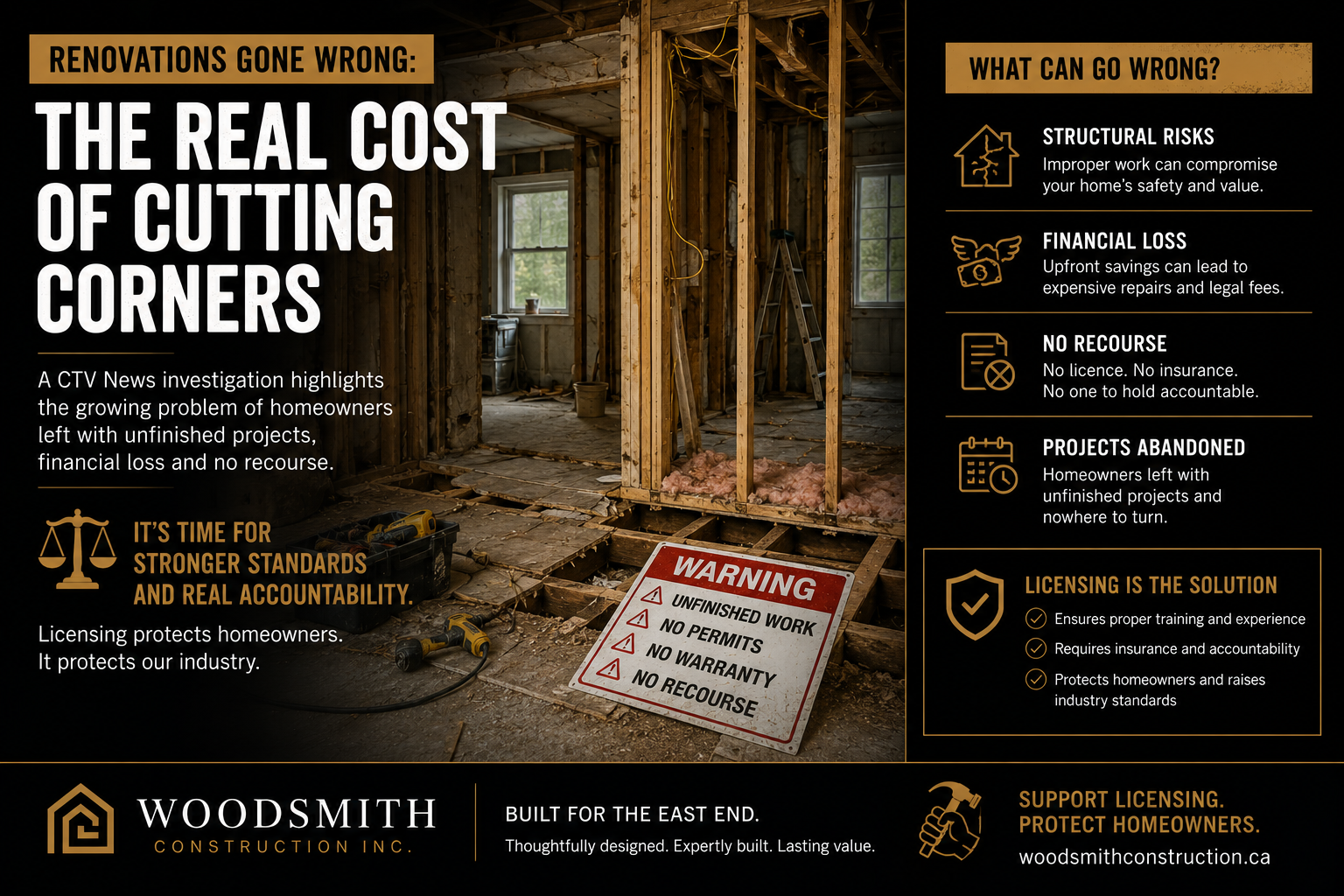
This is the first in a short series on something our industry doesn’t talk about honestly enough: why so many renovations go wrong, what it’s costing homeowners, and what could actually fix it.
Every few weeks now there’s another story. A homeowner hands over tens of thousands of dollars for a renovation, and the contractor disappears, or the work is left half-finished, or — worse — it gets “finished” in a way that turns out to be unsafe. The one that prompted me to write this was a recent CTV News investigation, “‘He just disappeared’: This contractor has a long list of angry clients,” which follows a GTA contractor whose clients across Brampton, Richmond Hill and beyond say they paid for work that was never completed — in some cases never even started. One man had set aside money for a basement apartment to bring in income after an illness left him unable to work, and says it simply vanished.
Stories like that are painful to read, and they’re a black eye on everyone who does this work honestly. But if we want fewer of them, we have to be clear-eyed about why they keep happening — because it isn’t only outright fraud.
There are two kinds of “gone wrong”
The first kind is the one that makes headlines: bad-faith operators who take deposits and run. Those people are a small minority, but they do real damage, and they’re getting bolder.
The second kind is quieter, more common, and in some ways more expensive: contractors who simply don’t know what they don’t know. Someone does a few bathrooms and kitchens, feels ready to take on a whole-home renovation, and makes assumptions about work they’ve never actually done. There’s no fraud involved. There’s just a gap in experience — and in an older home, that gap can be enormous.
Here’s a real example from our own files. A client in the east end had “renovated” their home years earlier, purportedly all with a permit. While we were working on their first floor, we opened the ceiling and found that the second floor they’d been living on for twelve years had never been properly framed — the joists were sized to hold up a ceiling, not a floor full of people and furniture, and they were spanning up to fourteen feet. It had been hidden from the inspector, and there was no way for anyone to catch it after the fact. We had to reframe it as we went. That one piece of someone else’s shoddy work cost our client almost $100,000 in extra materials and labour.
Nobody set out to hurt that family. But the outcome was the same as if they had.
Why it keeps getting worse
Renovation demand has grown enormously over the last twenty to thirty years, and it’s going to keep growing — it’s simply a function of the math. We built a lot of housing, that housing is aging, and in most of the neighbourhoods we work in you can’t knock a house down and start over — so people renovate. Older homes need a genuinely skilled hand to bring them up to modern energy and safety standards, and the walls of a hundred-year-old house hide surprises that a newer build never would.
At the same time, the bar to call yourself a renovator is basically zero. Anyone with a truck and a business card can take a deposit tomorrow. That combination — high demand, aging and complicated homes, and no real gatekeeping — is exactly why the stories keep coming.
How to protect yourself right now
Until something changes at the industry level, the best protection is your own due diligence. If you’re planning a renovation, a few habits go a long way:
- Follow the permit. If the work needs a building permit, make sure one is actually being pulled, and know who is pulling it. Permitted work gets inspected — that’s your safety net.
- Check credentials, not just Instagram. Ask what the contractor and their designer are actually certified to do (for example, BCIN for design, Red Seal for the trade). Qualifications are verifiable; a nice portfolio isn’t.
- Confirm current insurance — both kinds. Liability insurance and errors-and-omissions coverage, in force today. You’d be surprised how few carry proper coverage.
- Be suspicious of a firm price quoted before anyone opens a wall. In an older home, that number is a guess. Understand how change orders and surprises will be handled before you sign.
- Never fund the whole job up front. Structure payments to the work, and keep them tied to real progress.
- Get it in writing, and check references. A clear contract and a couple of real, recent clients you can actually call will tell you more than any sales pitch.
Woodsmith Insight: A low number on a page is not a price — it’s a guess about work nobody has looked at yet. The contractors worth hiring will tell you what they don’t yet know and how they’ll handle it. That honesty, more than any single line item, is what protects your budget and your home.
The bigger fix: giving homeowners a way to know
Personal due diligence helps, but it puts the entire burden on the homeowner — and that isn’t really fair. The deeper fix is to give people a simple way to know, before they hand over a dollar, whether the person doing permit-related work on their home is actually qualified.
That’s where the conversation around renovator licensing comes in. I sit on OHBA’s Renovators’ Council, and it’s an idea a lot of us in the industry are actively working through: a framework, focused on permit-related work, that would let a homeowner ask one clear question — “Was that contractor licensed?” — and get a real answer. Done right, it wouldn’t be about piling red tape on legitimate builders; it would be about drawing a clear line between qualified professionals and the underground operators who cause most of the harm.
There’s a lot more to say about what that framework should — and shouldn’t — look like, and I’ll get into the specifics in the next piece in this series.
For now, if you’re weighing a renovation and want to start with someone who’ll be straight with you about what it really involves, get in touch. And if you want the bigger picture on where renovation, licensing and building science are all heading, I wrote about our panel at The Buildings Show here: The Future of Renovation in Ontario.
Next in this series: what a practical, fee-light renovator licensing framework could actually look like.
There is one place where that protection already exists in law, and most homeowners never realise it applies to them. If your project is legally a new home rather than a renovation — and a backyard suite, or a rebuild that keeps the old foundation, can be exactly that — then your builder must hold an HCRA licence and the dwelling must be enrolled with Tarion before construction starts. Get that wrong and there is no warranty at all. We’ve mapped out where the line between a renovation and a new home actually falls, and how to check a builder’s licence in about five minutes.
Frequently asked questions
Verify that permits are being pulled, confirm professional credentials (e.g., BCIN for design, Red Seal for the trade), ask for proof of current liability and errors-and-omissions insurance, and check recent references. Ontario does not yet license renovation contractors for most permit-related work, so this due diligence is on you for now.
New-home builders are licensed through the HCRA, but most renovation work falls outside that. A licensing framework for permit-related renovation work is an idea currently being discussed through OHBA’s Renovators’ Council — more on that in the next post.
A firm price quoted before anyone has opened a wall, pressure for large up-front payments, no permit, vague or missing credentials, no written contract, and no verifiable references.
Document everything, stop further payments, and get advice. The recent CTV investigation into a disappearing GTA contractor is a reminder of why hiring on credentials — not price — matters so much.