




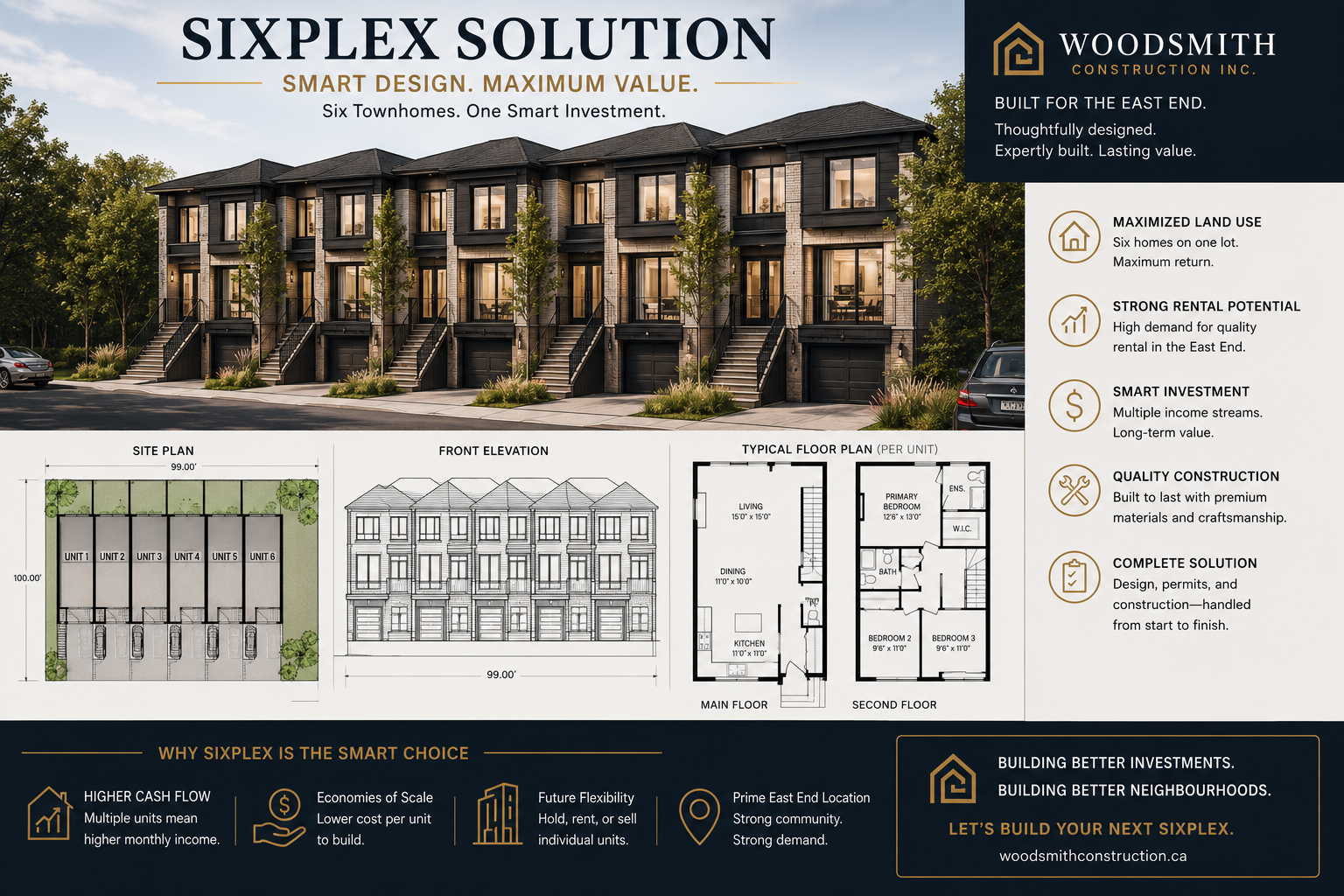
It’s the question we’re hearing more than any other right now. A homeowner in Riverdale, the Beaches, or East York reads that Toronto has changed the rules — that you can now put up to six units on an ordinary residential lot — and they call to ask the obvious next thing: can I do that to my house?
The honest answer is: maybe, and probably more than you think. But “allowed” and “buildable” are two different words, and the distance between them is where most of these projects either find their footing or fall apart. The zoning headlines are written from a desk. The actual job happens inside a ninety- or hundred-year-old house that was never designed to be pulled apart into separate homes — and that house has opinions.
This is the part of the conversation the investor blogs and the realtor explainers skip. So let’s have it properly: what the rules actually permit on your lot in 2026, and what it really takes to turn a century-old East Toronto house into legal units.
What you're actually allowed to build in 2026
Start with the rules, because they’re better than most people realize — and more specific.
Across all of Toronto, four units are permitted as-of-right on a residential lot. That’s been the case since 2023, and “as-of-right” is the important phrase: it means you don’t need a rezoning or a trip to the Committee of Adjustment to do it, as long as your design respects the ordinary limits on height, setbacks, and the like.
Six units is the newer, more powerful permission — and it’s geographic. In June 2025, City Council adopted the by-laws allowing up to six units as-of-right in the Toronto and East York District plus Ward 23 (Scarborough North) — nine wards in total. If your home is in Leslieville, Riverdale, the Danforth, the Beaches, or most of East York south of Eglinton, you are very likely in the sixplex zone. The amendments are in force now.
A few details that change the math in your favour: development charges are waived on the first six units, parking minimums are gone, and a garden suite or laneway suite is additive — it doesn’t count against the unit cap, so a six-unit main house can still add a suite at the back.
Two cautions worth stating plainly. First, Leaside is mostly north of Eglinton, which puts it outside the sixplex wards — Leaside lots are fourplex-only. Second — and this is the important update for 2026 — don’t plan around six units arriving city-wide. After studying it, City Council declined to extend as-of-right sixplexes across the city, and the federal government responded by clawing back part of Toronto’s housing funding in protest, citing the remaining restrictions on missing-middle housing. Six-unit permissions are not spreading automatically: a ward gets them only if its local councillor opts in, and most wards outside the original nine have not. So the nine-ward map is the one to plan around today — not a citywide expansion that Council has, for now, turned down. (City of Toronto — Multiplex / Sixplex study)
"Allowed" is a zoning word. "Buildable" is a construction word.
Here’s where our chair differs from the realtor’s. Once the units are permitted, the project stops being about zoning and becomes about a building that has stood, settling and shifting, since before the Second World War. Converting it into legal, separate homes means satisfying the Ontario Building Code unit by unit — and an old house resists that at every turn.
The four places it pushes back hardest are fire separation, egress, ceiling height, and water. None of them show up in a zoning summary. All of them show up in the budget.
Fire separation and party walls
The moment a single-family house becomes multiple dwelling units, the Code wants every unit boxed off from its neighbours by fire-rated assemblies — floors, ceilings, and the walls between units all built to hold fire and slow its spread, typically for 45 minutes to an hour, with sound control to match.
In a new build you draw those assemblies once and frame them. In a conversion you’re retrofitting them into a house with balloon framing that runs uninterrupted from the basement to the attic — the exact path fire and sound love most. Closing those cavities, fire-stopping them properly, and bringing old floor assemblies up to a real rating is patient, invisible work. It’s also where a lot of “I’ll just frame a few walls” budgets quietly double.
If your house is a semi, you’ve met the cousin of this problem already: the party wall you share with next door. We’ve written before about how often party-wall obligations get ignored until they can’t be — and a multiplex conversion only raises the stakes.
Egress: every unit needs its own safe way out
Every legal unit needs a protected way out — and for below-grade units, that usually means a second exit. In practice that’s a code-compliant exterior stair down to a proper egress window or walkout, dug into the side or rear of the house.
On the wide lots of a new subdivision, fine. On a 20-to-25-foot East Toronto lot wedged against the neighbour, with a side yard you can barely turn sideways in, that exit stair becomes one of the hardest things on the whole project to place. Where the egress goes often dictates where the basement kitchen and bedroom can go, which means it quietly drives the entire lower-unit layout. We design these from the exit inward, not the other way around — it’s the constraint that humbles every optimistic floor plan.
Underpinning: the cost hiding under the basement floor
This is the big one, and the one most surprise budgets miss.
A basement unit has to be a real home, which means real ceiling height — the Code wants roughly six feet five inches of clear height in the living space. Most century East Toronto basements don’t have it. They were dug as cellars for coal and storage, not as bedrooms, and they often sit at six feet or less once you account for ducts and beams.
To get the height, you go down — underpinning the foundation, excavating beneath the existing footings in careful sequence and pouring new, deeper ones so the floor can drop. It’s some of the most skilled, most consequential work we do, and on an old brick foundation it’s unforgiving. Done right it’s invisible and permanent. Done badly it shows up as cracks, or worse. It’s also one of the larger line items on the job, and how much it costs depends entirely on the depth you need and the condition of the foundation you’re working under — but it’s frequently the difference between a legal basement unit and a storage room you can’t rent. We go deeper on why older homes carry costs like this in The Real Cost of Aging Homes in East Toronto.
The brick foundation and the water it lets in
Most of these homes sit on brick or rubble-stone foundations that were never waterproofed to any modern standard. Add living space below grade and you’ve raised the stakes on every drop of water that used to just dampen a cellar nobody slept in.
Proper conversion work usually means excavating to the footing, waterproofing the foundation from the outside, and putting in or upgrading the weeping tile and sump system. It’s not glamorous and no tenant will ever see it — but skip it and you’ve built bedrooms that flood. On an older East Toronto home this is rarely optional.
So what does it actually cost?
There’s no honest single number, and anyone who gives you one without seeing the house is guessing. The cost of converting an older home turns almost entirely on two things: the condition of the existing property, and how much of it the renovation has to touch. A solid, dry, square house with a deep-enough basement is a very different project from a settled one with a shallow cellar, a wet foundation, and knob-and-tube still in the walls — even on the same street, even the same size.
That’s why the meaningful numbers come from the house, not from a price list. The work that drives the budget is usually invisible: the underpinning, the exterior waterproofing, the fire and sound assemblies between units, and the service upgrades a house being split into four or six homes almost always needs — new electrical capacity, separate metering, HVAC zoning, and plumbing stacks. A home that needs all of it costs a great deal more than one that needs little of it, and the only way to know which one you’ve got is to look.
So rather than quote a number we can’t stand behind, we do the opposite: we start with a proper feasibility read of the actual property and give you a budget built on what your house needs. An honest assessment at the start is the cheapest part of the whole job. The expensive version is finding the surprise halfway through.
Woodsmith Insight: The lots that make the best multiplexes are rarely the ones that look easiest. We’d rather take on a solid, square brick house with a deep-enough basement and a workable side yard than a charming one with a shallow cellar, a shared wall, and nowhere to put an exit stair. Before you fall for the zoning permission, have someone who builds these — not just sells them — walk the actual house. The answer to “how many units” is written in the foundation and the side yard, not the by-law.
Build to what your lot allows today — don’t wait for citywide six
This is the genuine 2026 decision, and it’s worth naming honestly — because the answer changed this year.
If you’re in one of the nine sixplex wards, the path is open today — six units, no rezoning, development charges waived, a suite still possible at the back. If you’re north of Eglinton in Leaside or in much of the inner suburbs, you’re allowed four now — and you should plan as though four is what you’ll have. The hoped-for citywide expansion to six didn’t happen: Council studied it and declined, Ottawa docked part of the City’s housing funding over it, and any future expansion now depends on your local councillor choosing to opt your ward in. That may come someday, or it may not — but it is no longer something to build a plan around. Waiting on it has a real cost too: construction prices don’t tend to fall, and the units you don’t build are units you don’t rent.
So for most owners we talk to, the smarter move isn’t to bet on the by-law — especially now that citywide six has been turned down. It’s to design for the units you’re allowed today while building in the structure to add more later if your ward ever opts in. A house underpinned and serviced for four is a far shorter step to six than a house touched twice. The zoning will do what it does. The construction decision should be made on the house in front of you.
Where to start
A multiplex conversion lives or dies on the first two questions, and both are answerable before you spend real money: what does my lot actually permit, and what will this specific house cost to convert legally? That’s a feasibility conversation — the kind a BCIN-licensed designer and a builder should do together, on site, with the basement floor and the side yard in plain view. It’s also where we’d start, because everything after it — design, permits through the Committee of Adjustment if needed, and the build itself — is only as sound as that first read of the house.
If you’re weighing whether your older East Toronto home could become two, four, or six legal homes, let’s walk it together before you commit to a number. The rules have finally caught up to the need. The job is making sure the house can keep up too.
Frequently Asked Questions
No. Four units are permitted as-of-right city-wide, but six units as-of-right currently apply only in the Toronto and East York District and Ward 23 (Scarborough North) — nine wards, in force since 2025. City Council studied extending six units city-wide and declined, so the nine-ward map stands; other wards can gain six units only if their local councillor opts in.
Mostly no. Leaside sits largely north of Eglinton, which puts it outside the current sixplex wards, so Leaside lots are generally limited to four units in the main house. Since Council declined a citywide sixplex expansion, that won’t change unless Leaside’s own ward specifically opts in.
Often, yes. A legal basement dwelling needs roughly six feet five inches of clear ceiling height, and most century East Toronto basements fall short. Underpinning lowers the floor to gain that height. It’s one of the larger costs on the job, and how much depends on the depth required and the condition of the existing foundation.
There’s no single number — it depends almost entirely on the condition and age of the existing home and how much the conversion has to touch. The costs that move a budget are usually the invisible ones: underpinning, exterior waterproofing, fire and sound separation between units, and service upgrades like new electrical, separate metering, HVAC, and plumbing. The reliable way to get a real figure is a feasibility assessment of the specific property.
Yes. Garden and laneway suites are additive in Toronto — they don’t count against the unit cap — so a six-unit main house can still add a suite at the rear, subject to the usual suite rules.
In the nine sixplex wards you can build six today. Elsewhere you can build four now — and you shouldn’t count on six arriving, because City Council declined to make sixplexes city-wide and any expansion now depends on individual wards opting in. We usually advise designing for what’s permitted today while structuring the build so more units could be added if your ward later opts in — rather than betting the project on a by-law change that’s already been turned down once.